_edited.png)
FHA vs Conventional Loans Which Is Better for Your Home Purchase

A small difference in loan type can change your monthly payment, cash needed at closing, and how easy it is to get approved. That is why the FHA versus conventional loan decision matters so much, especially for buyers who are trying to balance savings, credit score, and long-term cost.
Both loans can help buy a home. Neither is automatically better. FHA loans often work well for buyers with lower credit scores or smaller savings. Conventional loans can be a stronger fit for buyers with better credit, more cash down, or plans to remove mortgage insurance later.
This guide compares the key differences in eligibility, down payments, interest rates, mortgage insurance, and real-life tradeoffs so the choice feels less confusing.
This article is for general information only and is not financial advice. Loan rules, rates, and approval standards can change, and lenders may apply their own requirements.

The short answer on FHA versus conventional loans
An FHA loan is a mortgage insured by the Federal Housing Administration. Because the government insures the lender against some risk, FHA loans often have more flexible approval standards.
A conventional loan is not insured by the FHA, VA, or USDA. Most conventional loans follow guidelines set by Fannie Mae or Freddie Mac. These loans usually reward stronger credit, lower debt, and larger down payments.
Here is the quick comparison.
Feature | FHA loan | Conventional loan |
Typical minimum credit score | Often more flexible, with FHA program minimums as low as 580 for 3.5% down, though lenders may require higher | Often around 620 or higher, depending on the lender and loan program |
Minimum down payment | 3.5% for many borrowers who meet credit requirements | As low as 3% for some qualified buyers, often 5% for many standard buyers |
Mortgage insurance | Usually required upfront and annually | Usually required with less than 20% down, but can often be canceled later |
Interest rate pattern | Often competitive for lower-credit borrowers | Often best for borrowers with strong credit and lower risk profiles |
Property use | Primary residence only | Primary residence, second home, or investment property, depending on program |
Property standards | FHA appraisal standards can be stricter | Appraisal standards are usually more flexible |
If credit or cash is tight, FHA may open the door. If credit is strong and long-term cost matters most, conventional may be cheaper over time.
How FHA loans work
FHA loans are popular with first-time buyers, but they are not only for first-time buyers. A repeat buyer can use an FHA loan too, as long as they meet the program rules.
The biggest appeal is flexibility. FHA guidelines allow lower credit scores than many conventional loan programs. FHA loans also tend to be more forgiving if a borrower has had past credit issues, as long as they have rebuilt their finances and meet waiting period rules.
FHA eligibility basics
Most FHA borrowers need to meet several core requirements:
The home must be the borrower’s primary residence
The borrower must have a qualifying credit profile
The borrower must show steady income and the ability to repay
The property must meet FHA appraisal and safety standards
The loan amount must fit within FHA loan limits for the county
Debt-to-income ratio also matters. This ratio compares monthly debt payments to monthly income. FHA loans may allow a higher ratio than conventional loans in some cases, especially when the borrower has strengths such as stable income, cash reserves, or limited payment shock.
For example, say a buyer has a 610 credit score, steady employment, and enough savings for a modest down payment. A conventional lender may see the credit score as a concern. An FHA lender may be more open to the file if the income, debts, and payment history support the application.
FHA down payment requirements
One of the best-known FHA features is the 3.5% down payment option for eligible borrowers. On a $300,000 home, that down payment would be $10,500 before closing costs and prepaid expenses.
FHA down payment funds can often come from savings, approved gift funds, or certain assistance programs. That can help buyers who have enough income to afford the monthly payment but have not built a large cash reserve yet.
There is a catch. FHA loans include mortgage insurance, and that cost can last a long time.
FHA mortgage insurance
FHA loans generally include two types of mortgage insurance:
An upfront mortgage insurance premium
An annual mortgage insurance premium paid monthly
The upfront premium is often financed into the loan, which means the borrower does not always pay it in cash at closing. Financing it raises the loan balance.
The annual premium becomes part of the monthly payment. In many FHA cases, mortgage insurance stays for the life of the loan unless the borrower refinances into another loan type. Some FHA loans with larger down payments may have different cancellation rules, but many buyers should assume the monthly cost may be long term.

How conventional loans work
Conventional loans usually work best for borrowers with stronger credit, stable income, and enough savings to cover the down payment and closing costs.
They can be more strict than FHA loans, but they also come with benefits. The biggest one is flexibility. Conventional loans can finance a primary home, second home, or investment property, depending on the borrower’s qualifications and the lender’s program.
Conventional eligibility basics
Conventional lenders usually look closely at:
Credit score and credit history
Debt-to-income ratio
Employment and income stability
Down payment amount
Cash reserves
Property type and occupancy
A borrower with a higher credit score will often have access to better pricing. A borrower with a lower down payment or higher debt ratio may still qualify, but the rate and mortgage insurance cost can be higher.
For example, a buyer with a 760 credit score, low credit card balances, and 10% down may get strong conventional loan pricing. Another buyer with a 625 score and 3% down may qualify, but their interest rate and private mortgage insurance may cost more.
Conventional down payment requirements
Many buyers think conventional loans always require 20% down. That is not true.
Some conventional programs allow down payments as low as 3% for qualified buyers. Many standard conventional buyers put down 5%, 10%, 15%, or 20%, depending on their savings and goals.
A 20% down payment is still powerful because it usually avoids private mortgage insurance. On a $300,000 home, that means $60,000 down. That is not realistic for every buyer, but it can lower the monthly payment and reduce total borrowing costs.
Conventional mortgage insurance
Conventional loans use private mortgage insurance, often called PMI, when the borrower puts down less than 20%.
PMI cost depends on risk factors such as credit score, down payment size, and loan type. A borrower with excellent credit and 10% down may pay much less PMI than a borrower with fair credit and 3% down.
The major advantage is that conventional PMI can often be removed once the borrower reaches enough equity, subject to lender and loan rules. This can happen through regular payments, home value growth, or a combination of both.
That makes conventional loans attractive for buyers who expect to stay in the home long enough to benefit from PMI cancellation.
Eligibility differences that matter most
The question is not just, “Can I qualify?” The better question is, “Which loan gives me the best approval odds and the best cost for my situation?”
Credit score flexibility
FHA is usually more forgiving for lower credit scores. Program rules may allow lower scores than conventional loans, though lenders often set their own minimums.
Conventional loans tend to reward higher scores more clearly. A borrower with excellent credit may get a better conventional rate and lower mortgage insurance cost than they would with FHA.
A simple example helps:
Buyer A has a 600 credit score and 3.5% down
FHA may be the more realistic option.
Buyer B has a 740 credit score and 10% down
Conventional may offer a better long-term cost.
Buyer C has a 680 credit score and 5% down
Both options may be worth comparing side by side.
Debt and income flexibility
FHA loans can sometimes be more flexible with debt-to-income ratios. This helps buyers who have student loans, car payments, or other monthly debts.
Conventional loans can be stricter, especially if credit is average or the down payment is small. Strong credit, extra savings, or a larger down payment can offset some concerns.
Lenders do not look at one number in isolation. They review the whole file. A buyer with a higher debt ratio but strong savings may look different from a buyer with the same debt ratio and no emergency cushion.
Property eligibility
FHA loans come with property standards. The home must be safe, sound, and livable. If the appraiser notices peeling paint, broken handrails, major roof concerns, or safety issues, repairs may be required before closing.
Conventional appraisals also check condition and value, but they are often less strict about certain repair items.
This matters when buying an older home. If a house needs repairs, a conventional loan may be easier to close, assuming the borrower qualifies.
Down payment and closing cost differences
The down payment is only one part of the cash needed to buy a home. Buyers also need to plan for closing costs, prepaid property taxes, homeowners insurance, and possible reserves.
FHA can help when cash is limited
FHA’s 3.5% down payment can make homeownership possible sooner. Gift funds may also help with the down payment or closing costs if they meet lender rules.
For a $250,000 home, a 3.5% down payment is $8,750. That is still a meaningful amount, but it is far less than 10% or 20%.
The tradeoff is the mortgage insurance cost. FHA may reduce the upfront cash barrier, but the monthly payment may include mortgage insurance for many years.
Conventional can save money with more down
Conventional loans become more attractive as the down payment grows. A borrower with 10% or 15% down may get better PMI pricing than someone with 3% down. At 20% down, PMI usually goes away entirely.
For a buyer who has the cash, a conventional loan can reduce monthly cost and may create more equity from day one.
That said, using every dollar for a down payment can be risky. A buyer also needs money left for repairs, moving costs, and emergencies. A slightly smaller down payment with a healthy cash cushion may be smarter than draining savings to avoid PMI.
Interest rates are only part of the cost
Many buyers ask which loan has the lower interest rate. The answer changes with market conditions and borrower profile.
FHA loans often show lower quoted interest rates than conventional loans for borrowers with lower credit scores. That lower rate does not always mean the FHA loan is cheaper because mortgage insurance must be counted too.
Conventional rates are usually more sensitive to credit score, down payment, and loan structure. A high-credit borrower may see excellent conventional pricing. A lower-credit borrower may see a higher rate and higher PMI.
When comparing options, look at:
Interest rate
Annual percentage rate
Monthly mortgage insurance
Upfront mortgage insurance or funding costs
Total monthly payment
Cash needed to close
How long you expect to keep the loan
APR can help compare costs, but it is not perfect. The best comparison is a side-by-side loan estimate from the same lender on the same day.
A practical rate comparison example
Imagine two buyers purchasing a $325,000 primary home.
Buyer one has a 620 credit score and 3.5% down. The FHA loan may offer a more manageable rate and approval path. Even with mortgage insurance, FHA could be the better fit because the conventional loan pricing may be expensive.
Buyer two has a 760 credit score and 10% down. A conventional loan may have a strong rate and PMI that can be removed later. Even if the FHA rate looks slightly lower, the conventional loan could cost less over time.
The lesson is simple. Do not compare rate alone. Compare the full payment and long-term cost.
Pros and cons of FHA loans
Pros
Lower down payment for many buyers
More flexible credit requirements
Can be easier for borrowers with past credit challenges
Gift funds may be allowed
Helpful for buyers with limited savings
Cons
Mortgage insurance is usually required
Mortgage insurance may last for the life of the loan
Primary residence only
Property standards can create repair issues
Loan limits apply by county
FHA can be a strong bridge into homeownership. It is especially useful when a buyer has steady income but has not reached the credit or savings level needed for the best conventional terms.
The main concern is long-term cost. Some buyers use FHA to purchase the home, then refinance into a conventional loan later if their credit improves and equity grows. That can work, but refinancing is not guaranteed and depends on rates, home value, and qualification at that time.
Pros and cons of conventional loans
Pros
PMI can often be removed after enough equity
Strong borrowers may get better total costs
Can be used for more property types
Fewer FHA-specific property repair rules
No upfront FHA mortgage insurance premium
Cons
Credit requirements are usually stricter
Pricing can be costly with lower credit scores
PMI may be expensive with small down payments
Debt-to-income standards may be tighter
Approval can be harder after recent credit issues
Conventional loans are often the better long-term choice for borrowers with good credit and enough cash. They can also work well for buyers who want the option to buy a second home or investment property.
The weak spot is accessibility. A buyer with credit challenges may qualify more easily with FHA, even if conventional looks better on paper.
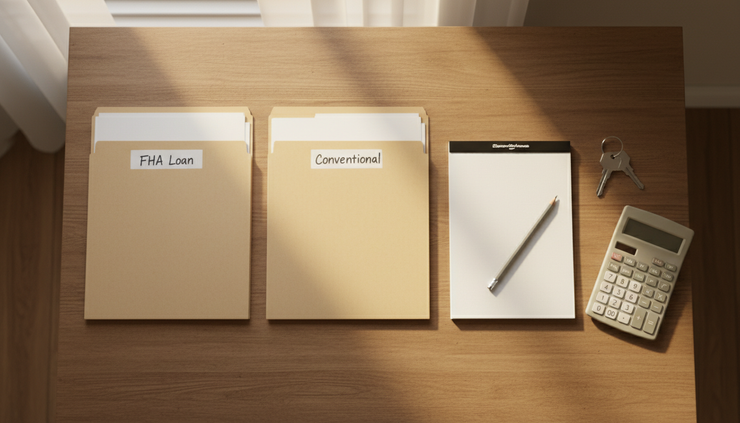
Which loan is better for your home purchase
The better loan depends on credit, savings, property type, and how long the borrower expects to keep the mortgage.
FHA may be better when approval flexibility matters
FHA may fit if:
Your credit score is below the range where conventional pricing looks strong
You have limited savings for a down payment
Your debt-to-income ratio is a concern
You are buying a primary residence
You need a loan program that is more forgiving of past credit problems
For example, a buyer with steady income, a 615 credit score, and 4% saved may find FHA gives them a realistic path to approval. The monthly mortgage insurance is a drawback, but getting approved may be the main hurdle.
Conventional may be better when long-term cost matters
Conventional may fit if:
Your credit score is strong
You have 5%, 10%, or more to put down
You want the ability to remove PMI later
You are buying a second home or investment property
The home has condition issues that may not meet FHA standards
For example, a buyer with a 750 score and 15% down may prefer conventional because PMI may be modest and temporary. The total cost could be lower than FHA, even if the quoted FHA rate appears attractive.
Both options may deserve a quote
Many buyers fall in the middle. A 680 credit score, 5% down, and stable income could work for either loan. In that case, the best move is to ask for both estimates.
Compare the monthly payment, cash to close, mortgage insurance, and long-term plan. If one option only saves a small amount upfront but costs much more over time, it may not be the better deal.
Questions to ask before choosing
Before committing to either loan, ask the lender direct questions:
What is the total monthly payment, including taxes, insurance, and mortgage insurance?
How much cash do I need to close?
How long will mortgage insurance last?
Can the mortgage insurance be removed later?
Are there property condition concerns with this loan type?
What would the payment look like with a slightly larger down payment?
How do FHA and conventional estimates compare on the same purchase price?
A good loan comparison should make the tradeoffs visible. If the answer is only “this rate is lower,” ask for the full cost picture.
The best choice is the one that fits the full picture
FHA and conventional loans solve different problems. FHA can make approval easier when credit or savings are limited. Conventional loans can offer lower long-term costs for buyers with stronger credit, larger down payments, or plans to remove PMI.
For many buyers, the smartest step is not guessing. Get both options priced with the same home price, down payment, and timeline. Then compare the full monthly payment, cash needed at closing, and mortgage insurance rules.
The right mortgage is not just the one that gets you into a home. It is the one you can afford comfortably after the keys are in your hand.


Comments